For Australian Tradies & Local Service Businesses
Show Up When Locals Search for Your Trade
Local SEO puts you in front of people actively looking for what you do — in the suburbs you actually work in.
Straight through to the person who'd actually do the work — no call centre.
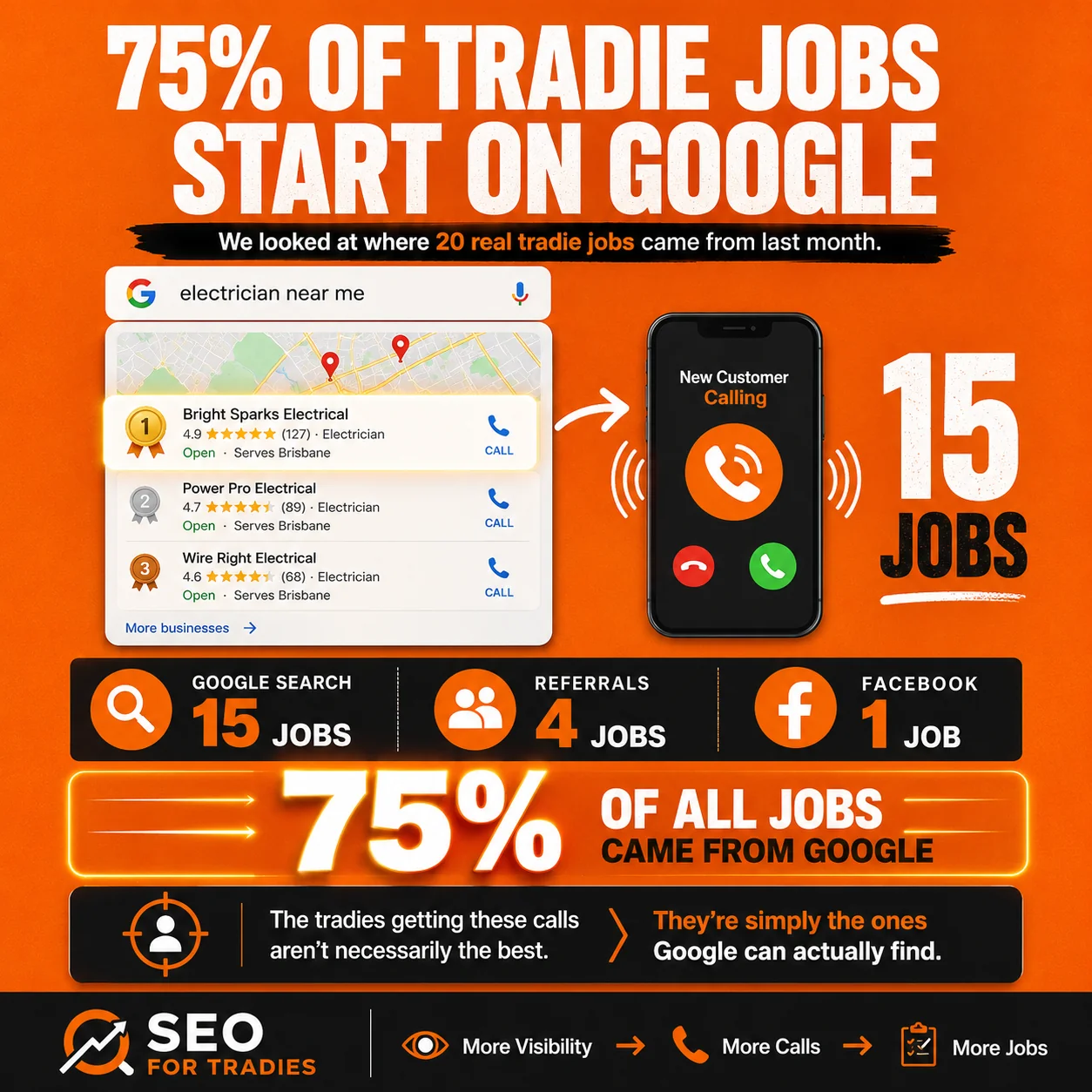
If your business doesn't show up when someone nearby searches for your trade, that job goes to a competitor who does — and you never even knew it was available.
That's the quiet cost of poor local SEO. Not a dramatic loss. Just a steady, invisible drain of jobs you never had a chance to quote.
Local SEO for tradies isn't about chasing national rankings or writing content for algorithms. It's narrower and more practical than that: it's about making sure that when someone in your service area searches for what you do, your name is one of the first three things they see.
How local search actually works
When someone types "plumber near me" or "sparky in [suburb]" into Google, three things determine what they see:
- The map pack — three local businesses shown at the top of results, pulled directly from Google Business Profile. This is where most clicks go for local searches.
- Organic results — the standard web page rankings below the map pack, where your website competes on relevance and authority.
- Google Maps — increasingly used on mobile to find local services directly.
All three are connected. Your Google Business Profile feeds the map pack. Your website supports both your Business Profile authority and your organic rankings. Local signals — citations, reviews, consistent business information — reinforce the whole thing.
Most tradies have at least one of these working poorly, which leaves ranking position (and the jobs that come with it) on the table.
Google Business Profile: the fastest lever
Your Google Business Profile (formerly Google My Business) is the single most important local SEO asset for a tradie. It's what drives map pack visibility. A neglected or incomplete profile is one of the most common and most fixable local SEO problems we see.
What a well-managed profile looks like:
- Complete business information — services, service areas, hours, photos
- A consistent stream of genuine reviews (with responses)
- Regular Google Posts showing recent work, offers, or updates
- Correct category and service selections
- Questions answered and spam reviews flagged
A plumber we work with had been trading for years with an unclaimed Business Profile. When we claimed it, filled it out completely, and started actively managing reviews and posts, they moved into the map pack for their main suburb within a few months — without touching their website.
On-site local SEO: making your website work harder
Your website backs up your Business Profile and helps you rank in suburbs and for service types that a single profile can't cover. The key elements:
- Location pages — dedicated pages for each suburb or area you service, with relevant content (not just a list of postcodes)
- Service pages — separate pages for each core service (not one long "we do everything" page)
- Consistent name, address, phone number (NAP) across your site and all directories
- Fast load times and mobile-first structure — Google ranks sites that perform well on mobile
- Schema markup — structured data that tells Google exactly what your business is, where it operates, and what it does
These aren't tricks. They're signals that help Google confidently connect your business to the searches happening in your area.
Local citations and backlinks: building authority off your site
Everything above happens on your own property — your profile and your website. But Google also looks at what the rest of the internet says about your business. That's where citations and backlinks come in.
Citations are mentions of your business name, address, and phone number on other websites — directories like Yellow Pages, Hipages, True Local, and industry-specific listings. They don't need to link to your site to count. What matters is that the information is consistent everywhere. One listing says "Suite 4, 12 Smith St" and another says "4/12 Smith Street" — that's enough for Google to lose confidence in which details are correct.
A clean, consistent citation profile does two things: it confirms to Google that your business is real and established, and it gives your Business Profile the local authority signals it needs to rank in the map pack against competitors with more reviews or older profiles.
Backlinks are links from other websites pointing to yours. In local SEO, the most valuable ones come from locally relevant sources — your local chamber of commerce, a supplier's partner page, a local news mention, a trade association directory. A single link from your regional business chamber is worth more than dozens from random directories interstate.
You don't need hundreds of backlinks. Most tradies ranking well in their area have a handful of strong local ones — combined with a solid Business Profile and a well-structured site, that's usually enough. The key is relevance and trust, not volume.
What to focus on:
- Claim the obvious directories — Yellow Pages, Hipages, True Local, Yelp, your trade association. Make sure NAP is identical on every listing
- Fix inconsistencies — old phone numbers, outdated addresses, and misspelled business names on forgotten listings actively hurt you
- Earn local links — sponsor a local sports team, join your local business chamber, get listed on supplier websites, contribute to a local community page
- Avoid link schemes — buying bulk links from overseas directories or link farms will do more damage than doing nothing at all
We run a citation audit for every client we take on. It's one of the first things we check, because it's often one of the easiest wins — fixing a handful of inconsistent listings can shift map pack rankings within weeks.
Systems, not one-off tactics
Local SEO works through consistency over time. A single burst of activity — optimising your profile once, writing a couple of pages — will deliver some results and then stall. What sustains and compounds rankings is a steady rhythm: review generation, profile maintenance, content updates, citation building.
That's why we treat local SEO as an ongoing system, not a one-off project. The tradies who rank well in competitive suburbs usually have someone maintaining the machine in the background — not just someone who set it up years ago and walked away.
If you want to see where you currently stand — which searches you're showing up for, what competitors are outranking you, and where the quick wins are — a call with us is a good place to start.
No lock-in contracts
We build what works, and you stay because it does. Leave whenever you like.
You talk to the operator
The person who builds your system is the person who answers the phone. No junior account manager.
Live in 2–3 weeks
From brief to launch, once your content's sorted. We handle the build — you review and approve.
Frequently asked questions
What is local SEO for tradies, exactly?+
Local SEO is the process of getting your business to appear prominently when someone nearby searches for your trade — in Google's map pack, organic results, and on Google Maps. It combines your Google Business Profile, on-site optimisation, and local signals.
How long does local SEO take to work?+
Most trades see meaningful movement in the map pack within two to four months. Organic rankings can take longer. The Google Business Profile tends to move fastest with consistent optimisation.
Do I need a website for local SEO to work?+
A website strengthens your local SEO significantly — especially for suburb-specific rankings. A Google Business Profile alone can get you into the map pack, but a well-built site extends your reach to more searches and more suburbs.
What is the Google map pack and why does it matter?+
The map pack is the three business listings that appear at the top of local search results, above organic results. It gets a large share of clicks for searches like 'plumber near me' or 'electrician [suburb]'. Ranking in the map pack is often worth more than ranking #1 organically.
Can I do local SEO myself?+
You can manage the basics of your Google Business Profile yourself. But consistent optimisation — reviews, posting, location pages, citation building, on-site content — takes time and technical know-how. Most tradies find it pays to have someone else run it.
Is there a lock-in contract?+
No lock-in contracts. Local SEO is an ongoing system, not a one-off tactic — but you're not locked in if it's not working.
Ready to get more jobs?
See everything we do to help local businesses get more calls, more reviews, and more booked work. Give us a ring — no pressure, no BS.